m i r r o r
A winning competition entry by HMXW Arkitekter, Stockholm, during autumn 2011
Project managers: Tove Leander MSA and Frida Jahnmatz SAR/MSA
Introduction
The objective of the competition was to transform two existing water towers in the county of Haninge, Sweden into new and outstanding landmarks. The task contained two requirements - turning the towers into true landmarks and illuminating the towers. The water towers are very closely located. It is important to create an attractive dual harmony as well as some individual contrast between the two bodies. The objective being to bring a new focal point to the area – a noticeable, but not to dominating, landmark to be intrigued by.
The Vision
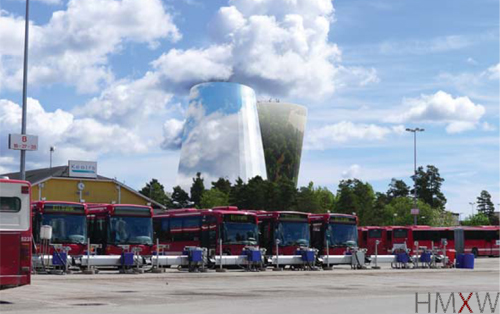
The sketch process started by assessing the embedded dynamics of the two towers. How can they communicate and still keep their individual identities? This triggered a concept of two similar bodies with their own qualities that together complements and unifies each other. The water towers need to give something back to its environment both from near and far. This introduced the idea of using a reflective material at an early stage. This would enable the new landmark to reflect the beautiful open scenery in Haninge without competing with it. Different kinds of expressions were tried until the sketch was simplified into two cones that were constantly adapting to its surroundings; one cone pointing at the sky and the other at the ground. The bodies communicate with its environment as well as creating their own strong identity for the municipality.
The Concept
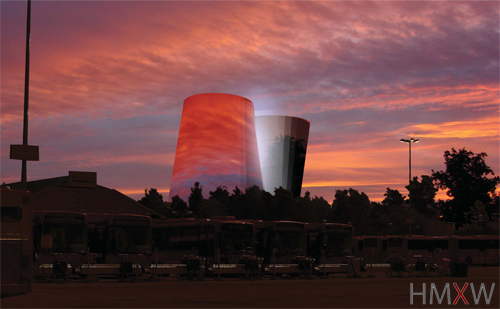
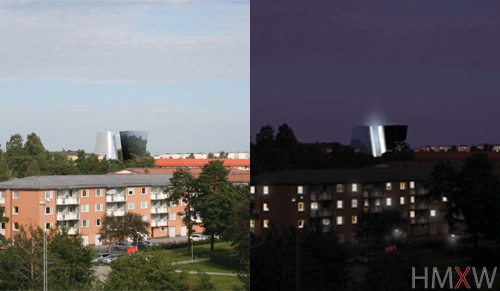
The two towers are antipodes but still join and strengthen the dual impression, the southern tower has an envelope surface that angles to the ground and reflects the dark colours and movements at the base of the tower. The envelope surface of the north towers is facing the sky and reflects the change in light. This means that the towers are alternating giving the reflections of the diurnal lights, one during day time and the other during the night. Another effect is that the colours vary depending of the season as well as the activities of the sun and moon. This will be widely emitted - a landmark in constant change.
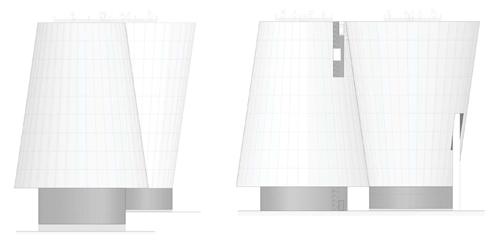
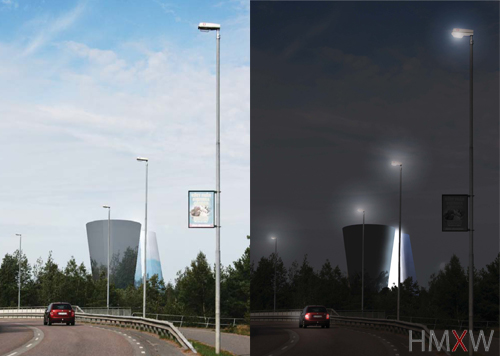
To indicate the tight fellowship of the towers but also to keep the natural fluctuations of light visible it is of importance that the illumination of the towers is kept to a very narrow path, the gap between the two. Since the towers are closely positioned the new envelope surfaces are almost touching each other by only some meters apart. However, this gap ties them together and that is why the space is illuminated during night time. The narrow distance has the consequence that, depending on your viewing point, there will be a different façade and a different relationship between them as you circle around the towers.
The Construction, Energy and Material
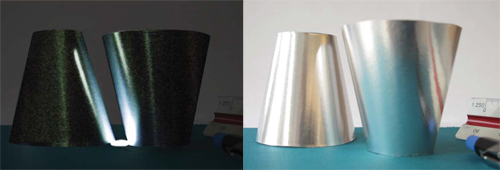
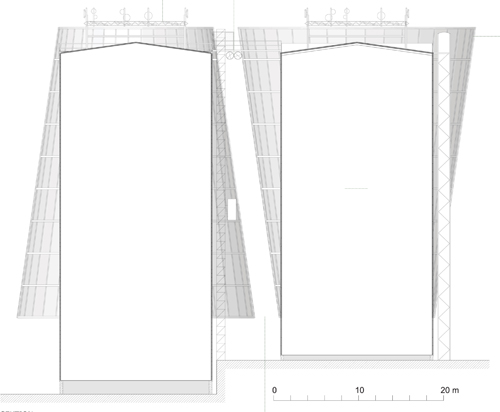
The original shape and construction of the two water towers are kept untouched. The new cone-shaped facades will be hanging from the existing surface and forming a new shell around the existing shape. The shells consist of identical modules of a reflective material. To be independent of electrical power there will be wind mills located under an existing bridge between the two towers. This power supply together with additional solar panels will provide the necessary electricity needed to illuminate the towers.
Illumination
The concept is to make use of existing natural light, both during day and night. To achieve a more refined effect the lightning of the towers are enhanced by artificial light during the night that accentuates the space between the two cones and makes the bodies part of the darkness and the void the focus.