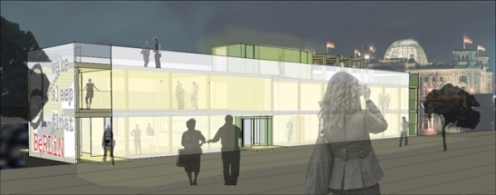
a w a k e | a s l e e p | a f l o a t
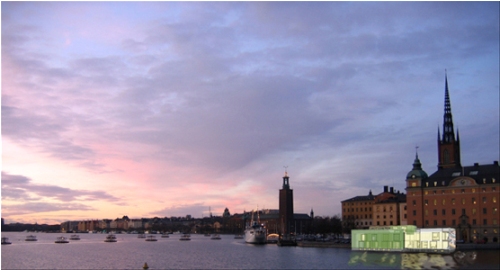
My vision is to create a relatively small hostel/hotel on water that could be towed around the world to where it is needed may it be temporary accommodation for a festival, a flooded city or a permanent fixture in an already too densely built city. The building should be flexible, adaptable and optimally used - both in appearance and in practical use. I also strived to design the building so it holds an exclusive but reserved expression that will turn it into a visual point in the city, but keep it humble enough not to impose on the city. The solution is a construction floating on water, in order to use vacant surfaces on a location, with an outstanding exterior and specially designed interior and furniture.
This is my master thesis project and was produced during the spring of 2008.

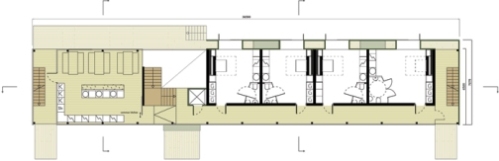
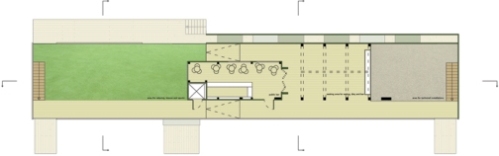
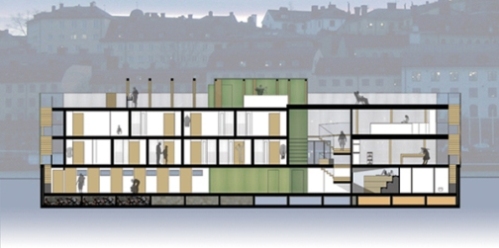
The hostel/hotel has three stories with different use and possibilities to populate. All the floors are divided into two sections, one common (left) and one private(right). The private section holds the sleeping areas and the common section is for socializing. The sections are kept apart with the communication facilities (stairs and elevator) to reduce the disturbance between the two functions. The different accommodations on the floors are: the sleeping quarters, the hotel rooms and the studios.
The lower floor hold the sleeping quarters that lies half submerge where budget travellers can find a cheap bed – more like a traditional hostel. The sleeping quarters are flexible and can accommodate a person travelling alone up to an entire school class. The only thing that separates the beds from each other is a curtain on both sides that can be opened or closed depending on how much interaction that is wanted. There are storage spaces for every bed and shared bathrooms. This floor also offers a small TV/Film theatre with Internet access and washing possibilities for the guests plus cabinets and areas for the hostel/hotel personnel and technical installations.

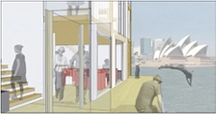
The entrance floor contains rooms with at a higher price range as they provide a view that can be very attractive. This storey harbours the hotel rooms which are flexible and can host up to four people sleeping in each one of them. The rooms can be used by a family travelling or a group of backpackers that want to have some more privacy after a long time on the road. The common area on this floor holds a large room with a bar and a reception making a connection with the water outside via a terrace. This space is also for public use – you can lease it as a small conference or party venue.

The upper floor has the most luxurious accommodations – the studios. These are meant for people how wants a more private or spatial accommodation during their stay with a good outside view. The visitors have a choice of cooking for themselves and more spacious rooms. In the public area of the floor there is a joint kitchen for the hostel/hotel where all guests can cook their own food and interact with each other.
On the top of the building is the roof terrace with a public bar that can be reached by an exterior staircase. There is a barbeque/relax area for the guests of the hostel/hotel and a green area with space for sporty activities provided plus a “technical park” for equipment such as windmills and solar panels.
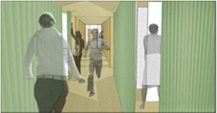
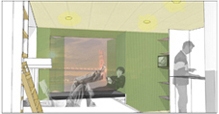

The development of the hotel rooms: To allow the dwelling to be subtle and discrete it was important to keep it small. This criteria depends on the size of the hotel rooms. They should be as compact and small as possible to maximize the available area. The beds, bathrooms and sofas, and bed storages - have been specially designed to make the room efficient and practical, every part of the rooms has been carefully considered and the solutions for space saving are quite distinctive.

The Bed: Since the bed is the most important piece in a hotel room emphasis was made to optimize the use both during the day and in the night, it also must be adaptable to varying number of guest staying in the room. The bed can take four different shapes; completely closed as a part of the wall and thus provide free space in the room. Pull down the board the wall and gain a table. Pulled down bed to accommodate two people and when needed a spare bed can be pulled down as well and a ladder attached to the bookshelf giving easy access. The beddings are stored in the two build in cupboards on the right hand side of the bed. This makes a compact living furniture with many possibilities.
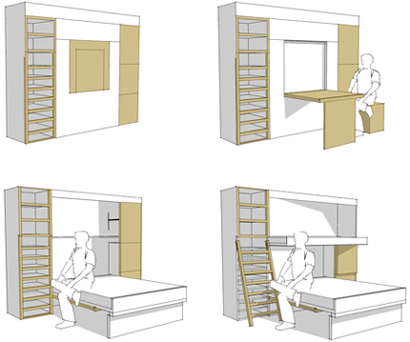
Other furniture in the hostel/hotel has been specially designed, for example has the hand basin/shower been designed to adapt to different stages during the day.

The Hull: The concrete hull is a double-hull construction where the external one is cast as a one-piece reinforced concrete hull without any casting joints and can stay submerged for some 100 years. The external surface does not get any coating or similar treatment. The two hulls are seperated with spacing for air to run through as insulation. The inner hull is additionally insulated with 150 mm coating; in this gap there is space for water and sewage tanks as well as room for additional ballast. This concrete structure and the wooden and plastic construction on top of gives the dwelling a favourable low centre of gravity and thereby good and reliable properties in the water - it will not easily rock and there is no a risk of capsizing. Calculations have been made and it shows that according to Archimedes? Principle: Buoyancy = density of the fluid x the gravity x the volume of the dispersed fluid - The mass of dispersed water equals: 668.4 tonne (fresh water) and 684.2 tonne (salt water) will enable the vessel of 590 tonne will keep the right water level. (A huge thanks to Henrik Lanner for his help with the calculations).
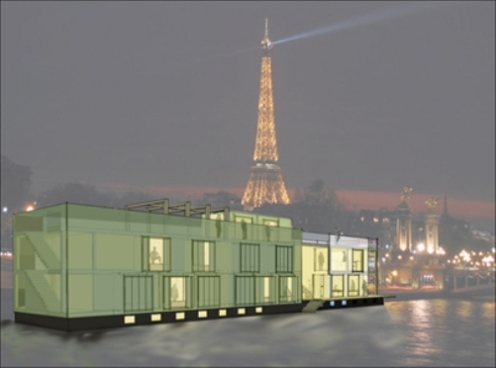
The Façade The entire upper body of the dwelling, and some walls within the building, are made out of a transparent material that is quite unique and enables light to shine through into any part of the building and does still meet the same insulation criteria (Swedish u-värde) as a normal wall structure. The colours of the façade can be decided for each dwelling that will be built, everything to make each building unique and more adaptable to its environment. This will bring the façade to life and reveal some of the interior to the outside world and the other way around. It will make the dwelling glow like a light buoy from inside at night and passer-byers can see the diffused movements within the building, at daytime is the situation reversed.
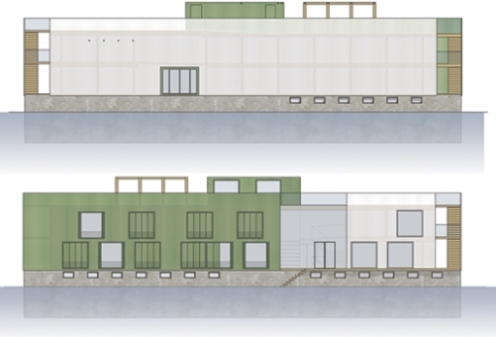
The so called stern of the dwelling is a wall enlightened by LED that will allow the hostel/hotel to project different images and/or information to the passing public and the guests staying at the hostel/hotel. The LED lights are fitted into aluminium profiles placed at some distance from each other to enable some translucency and opacity.